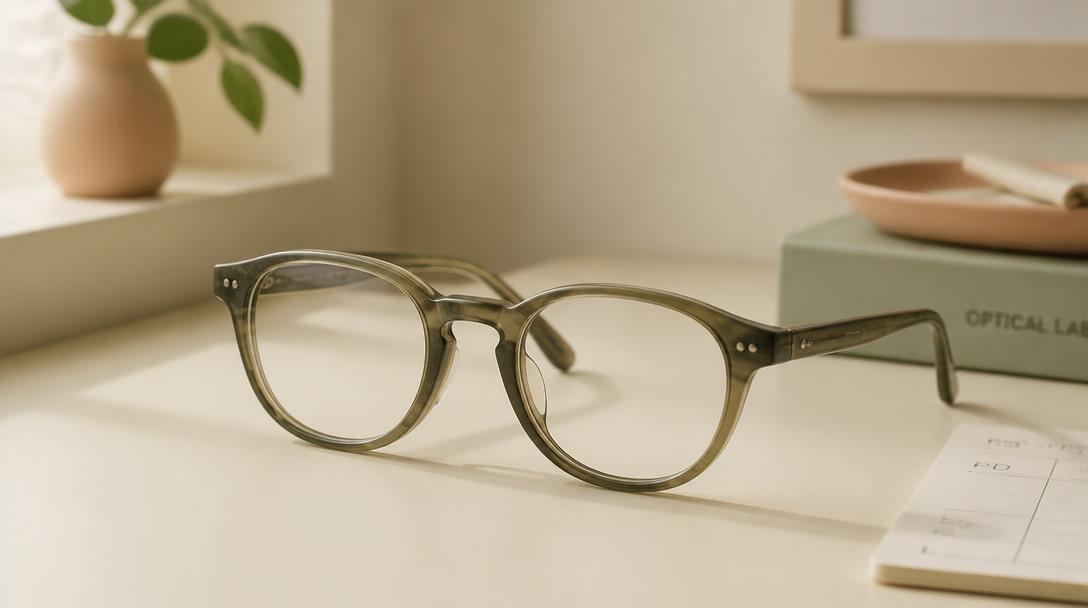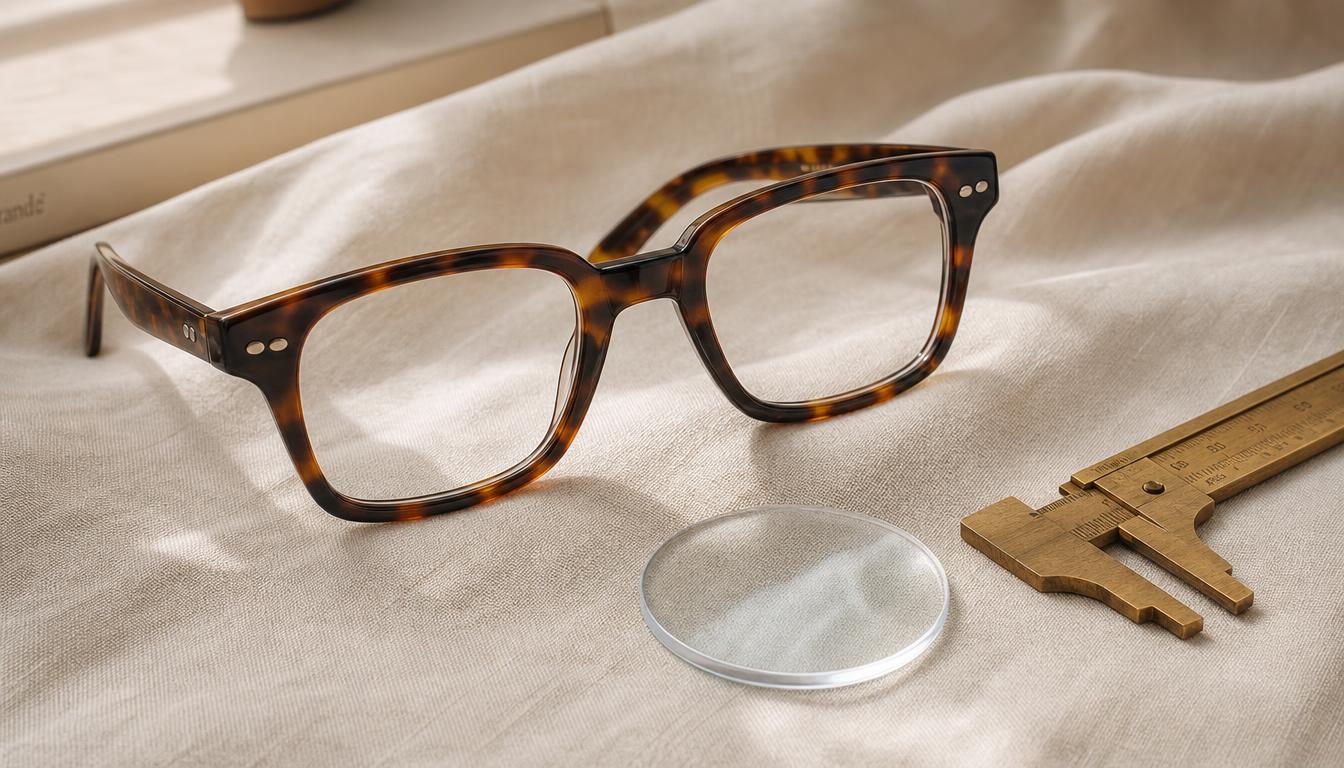
"Rx" just means prescription. Every pair of glasses you've ever worn to see better — as opposed to fashion sunglasses or safety goggles — has prescription lenses in them. This guide is a complete, jargon-free tour of what those lenses actually are: what your prescription numbers mean, what lens types exist, what coatings and materials matter, and how to pick the right combination for how you actually live.
It's designed to be the one page you can send to someone before they buy new glasses — the thing you wish someone had handed you the first time.
Reading your prescription
A prescription for eyeglasses (called an "Rx") has a few standard fields per eye. Here's what each one means:
- OD / OS — Latin for right eye (oculus dexter) and left eye (oculus sinister). Sometimes written simply "R" and "L".
- SPH (Sphere) — the main prescription strength. Negative = nearsighted, positive = farsighted. Measured in 0.25 steps (e.g. -2.75, +1.50).
- CYL (Cylinder) — the amount of astigmatism correction. Blank if you don't have astigmatism.
- AXIS — a number from 1 to 180 that tells the lab which direction your astigmatism runs. Only present if you have a CYL value.
- ADD — additional near-vision power for readers, bifocals, or progressives. Present only if you're presbyopic (typically 40+).
- PD (Pupillary Distance) — the distance between your pupils in millimeters. Usually 55–72mm. Critical for centering the lenses correctly in your frame.
The three main lens types
Everything else is a variation on these three:
Single vision
One prescription across the whole lens, corrected for a single distance (usually far). The most common lens type in the world. If you don't have an ADD value on your prescription, you get single vision. Deep dive on single vision →
Bifocals
Two prescriptions in one lens, separated by a visible line — distance on top, reading on the bottom. Rare in new prescriptions today; almost everyone who used to get bifocals gets progressives instead. When bifocals still make sense →
Progressives
A smooth transition from distance through intermediate to near, blended into one lens with no visible line. The modern default for anyone who needs both distance and reading correction. Comes with a small adaptation period and a lot of nuance around lens design quality. Common progressive problems (and fixes) →
Lens materials
The material affects thickness, weight, impact resistance, and cost:
- CR-39 plastic (1.50 index) — the standard. Fine for mild prescriptions.
- Polycarbonate — thinner and much more impact-resistant. Standard for kids and sports glasses.
- Mid-index (1.60) — ~15% thinner than standard. Good for moderate prescriptions.
- High-index (1.67 / 1.74) — 25–35% thinner. Essential for strong prescriptions.
Coatings, plainly
- Anti-reflective (AR) — kills the reflection off the lens surface so people can see your eyes and you don't fight glare from headlights. Standard on every LensOnUs lens.
- Scratch-resistant hard coat — extends lens life significantly. Also standard.
- UV protection — blocks invisible UV that damages eye tissue over years. Standard.
- Blue light filtering — reduces the blue wavelengths screens emit. Genuinely helpful for heavy screen users; overhyped for everyone else.
- Photochromic (Transitions) — the lens darkens outside and clears indoors. What's new with Transitions →
- Polarized — kills horizontal glare from water, roads, snow. Huge quality-of-life for drivers and outdoor people. How polarization actually works →
Where LensOnUs fits in
We're a Utah optical lab. Every lens type described above — single vision, progressive, bifocal, in any material, with any combination of coatings — we cut in-house by opticians with 20+ years of experience each. You don't buy new glasses from us; you send us the frames you already own and we install fresh prescription lenses.
Strong prescriptions and high-index lenses
For most prescriptions, our standard polycarbonate lenses are thin and light, so we don't charge you for a thinner lens you don't need. For stronger prescriptions we automatically upgrade to high-index material: 1.67 above 4.00 diopters (+$40) or 1.74 above 9.00 diopters (+$80). It's the only upcharge in the whole process, and you'll see it before you pay.
That's the whole model. No middlemen, no chain-store markup, just the lab. Single vision starts at $79, progressives at $199, both including all the standard coatings above and free shipping both ways. See how the send-in process works →
Frequently asked questions
What does 'Rx' mean on lenses?
'Rx' is the traditional medical shorthand for 'prescription' — it comes from the Latin word 'recipe' meaning 'take.' In eyewear, 'Rx lenses' just means prescription lenses, as opposed to plano (zero-prescription) lenses in fashion glasses or basic sunglasses.
How do I read my eyeglass prescription?
Each eye has a SPH (sphere) value for nearsightedness or farsightedness, sometimes a CYL (cylinder) and AXIS for astigmatism, and possibly an ADD for reading if you're presbyopic. There's also PD (pupillary distance), measured in millimeters. If you're not sure what your numbers mean, our opticians can walk you through them.
What's the difference between single vision, bifocals, and progressives?
Single vision = one prescription across the entire lens (for one distance). Bifocals = two prescriptions separated by a visible line (distance up top, reading on bottom). Progressives = distance/intermediate/near blended smoothly with no line and no jump. Progressives are the modern default for anyone who needs both distance and reading correction.
Which lens coatings are actually worth it?
Three are basically non-negotiable and we include them standard: anti-reflective, scratch-resistant, and 100% UV. Blue-light filtering is useful if you spend 8+ hours a day at screens. Photochromic (Transitions) makes sense if you want one pair for indoors and out. Polarized is huge for anyone who drives, boats, or fishes.
How often should I get new prescription lenses?
When your prescription changes noticeably (typically every 1–3 years), or when your current lenses are scratched enough to bother you. There's no fixed schedule — trust your eyes. If you're squinting again or getting headaches, it's time.